

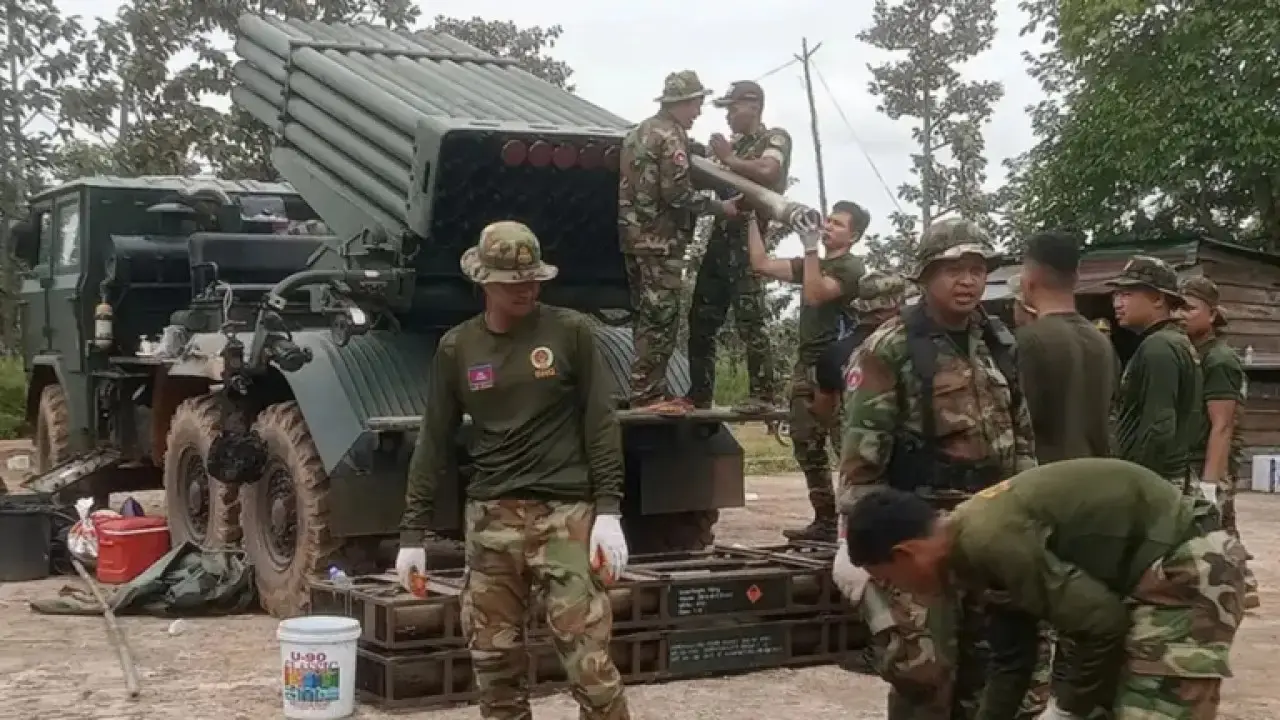
SAMRAONG, Cambodia — The leaders of Thailand and Cambodia are set to meet in Malaysia on Monday for peace talks, following four consecutive days of deadly clashes along their shared border.
The conflict, centered around long-disputed ancient temples in the frontier region, has already left at least 34 people dead and displaced more than 200,000 residents, with both sides exchanging artillery fire.
Bangkok confirmed on Sunday that Thailand’s acting Prime Minister Phumtham Wechayachai and Cambodian Prime Minister Hun Manet will participate in negotiations mediated by Malaysian Prime Minister Anwar Ibrahim, who currently chairs the Association of Southeast Asian Nations (ASEAN).
Anwar told Malaysian media that the talks, scheduled for 3:00 p.m. (0700 GMT), will focus on achieving an immediate ceasefire.
“They (government representatives of Cambodia and Thailand) have asked me to try and negotiate a peace settlement,” Anwar told national news agency Bernama.
“I’m discussing the parameters, the conditions, but what is important is [an] immediate ceasefire.”
As of Sunday evening, Cambodia had not released an official statement on the planned discussions.
Meanwhile, fresh artillery clashes were reported earlier that day near two of the ancient temples in the disputed area, continuing the hostilities that have plagued the region.
U.S. President Donald Trump, who spoke separately to both leaders on Saturday, said the two had agreed to “quickly work out” a ceasefire. However, Trump also threatened trade consequences if the violence continued.
“When all is done, and Peace is at hand, I look forward to concluding our Trading Agreements with both!” the U.S. president posted on social media.
Trump’s administration has previously warned both nations of potential tariff hikes unless they commit to independent trade deals and de-escalation of the conflict.
The disputed temples—relics of the ancient Khmer Empire—have been flashpoints between the two countries for years, with periodic flare-ups often resulting in casualties and civilian displacement.